Thursday, April 19, 2018

Cheers to Campaigning for Good

Humanitarian organizations often 'preach to the converted' in campaigns, urging the general public to donate, vote for their priorities or share facts and figures. These campaigns frequently are taken up primarily by existing supporters and by those who have some connection with the cause. The issues are serious, and the dedication to doing good is earnest. What happens when we make it fun?

Health organizations in particular are justifiably guarded about partnerships and reputational risks, particularly as they connect to practices that, when pursued in excess, can be hazardous to health. Here are two interesting examples of non-profit health organizations partnering with beverage companies to support viral campaigns to reach wider audiences than existing adherents.
In the old days of social media - 2011 - a mistweet by a member of the American Red Cross social media team proclaimed joy at finding supplies of Dogfish Head Brewery's craft beer. Headed home from teaching a Zumba class and looking forward to a quiet dinner with her husband, the woman accidentally posted on the American Red Cross account instead of on her personal account.
The error was well- and immediately managed by the team lead who deleted the tweet and replaced it with the quip, "We've deleted the rogue tweet but rest assured the Red Cross is sober and we've confiscated the keys." I remember talking with my colleague, who was worried about career and organizational damage the following day, and reflecting on the balanced and reasonable leadership. (Her career is thriving.)
In the social world, tweets live forever. The Brewery's followers and the social media manager picked up the tweet and, taken with the humane and humorous replacement tweet, started a fundraising campaign and donation drive: "'Show us you donated a pint @redcross today & we'll buy you a pint of @dogfishbeer #gettngslizzerd'".* The way the issue was handled and the quick thinking of both the brewery and the Red Cross turned this campaign into a highly successful marketing and fundraising activity.
Fever Tree malaria videoGin drinkers often cheekily cite malaria prevention when taking part in their favourite tipple. Centuries ago, a British colonial officer in India found that adding gin to the tonic water that contained antimalarial quinine was a lovely way to make the medicine go down. While modern medicine has much more effective preventive and treatment options for malaria, and one would have to drink gallons of modern tonic water to ingest sufficient quinine, tonic maker Fever Tree has found a way to make a more effective - yet equally delightful - contribution to the modern malaria fight.
Malaria remains a deadly and debilitating disease, and the WHO Africa Region bears 90% of the global death and disease burden. In 2016, nearly half of the world's population was at risk of malaria. The amazing part is that malaria is treatable and preventable. With the coordinated efforts of global partners and sufficient funds to prevent, diagnose, treat, and support research and development, this disease can be eliminated.
Partnering with Malaria No More UK on their #MalariaMustDie campaign, Fever Tree will donate £5 to the non-profit organization for every Twitter and Instagram 'Cheers!' post in April, tagged with #MalariaMustDie. Surely, you can add evidence that inventive and creative campaigns + new partners + social media = viral good.
You can wait till World Malaria Day on 25 April or simply raise a glass tonight to say 'Cheers! I believe that #MalariaMustDie'. I'm happy to join you... in the name of research, of course.
I currently am researching effectiveness of international humanitarian advocacy campaigns. If you have examples to share or reflections on campaigns in which you have been involved, please leave a comment.
* Blood donors should abstain from consuming alcohol immediately before and after giving blood. Follow all medical advice.
* Alcohol should be consumed responsibly and in moderation.

Thursday, March 17, 2016

St. Patrick's Day - the original Melting Pot celebration

An Irish colleague remarked today that her fellow Irish citizens were much less focused on St. Patrick's Day than her expat friends. Another colleague informed that St. Patrick's Day is a reason to get together with friends and drink beer. Yet another, passing our Irish quiz and Guinness-chocolate cake celebration, observed that, "on St. Patrick's Day, we're all Irish." These observation have roots and reasons.

According to University of Notre Dame scholar Diarmuid Ó Giolláin, "“St. Patrick’s Day was first celebrated in Montreal in 1759 by Irish soldiers in the British Army who had just conquered Quebec. The first St. Patrick’s Day parade in New York in 1766 was also by Irish soldiers in the British Army. And, on St. Patrick’s Day in 1768 in Montserrat (known as the Emerald Isle of the Caribbean), slaves revolted against the largely Irish Catholic plantation owners – a good reason for their descendants to celebrate the festival today."

March 17 has been, since its inception, a day to celebrate ethnic pride and traditions for those far from the homeland they love, however many generations back they trace their lineage.  It has been said mournfully that Ireland's most precious and plentiful export is its children. Like today's refugees and asylum seekers, Irish people have left the verdant, emerald shores of Ireland, shanghaied as conscripts, indicted as political "criminals" (hello, Australia!), fleeing hunger, seeking opportunity, and escaping violence and conflict.

The Irish have contributed and integrated into their communities - at least 22 of all U.S. presidents are of Irish ancestry - simultaneously celebrating their rich heritage and inviting others to do so.

Saint Patrick was not Irish. He was an immigrant and a slave. Today, celebrating St. Patrick's Day, join in toasting Irish heritage. And perhaps consider how our diversity and understanding of the world is enriched by coming together to celebrate and learn about one ethnicity while retaining and celebrating our own.

On 17 March, we are all Irish. Every day of our lives, we are part of a global community.

Thursday, September 3, 2015

Why a three year old on a beach may preserve our humanity

Why a three year old on a beach may preserve our humanity

Finnley (shark blanket) and
James (Photo: A. Kane)
My nephew Finnley celebrated his third birthday on Tuesday, surrounded by loving family in beautiful upstate New York. My brother posted a little video of him in an orange t-shirt leaping down some stairs and grinning proudly as he heard his father’s encouragement. Later, my sister-in-law shared a picture of Finnley in his new shark blanket, sitting on his father’s lap and smiling.

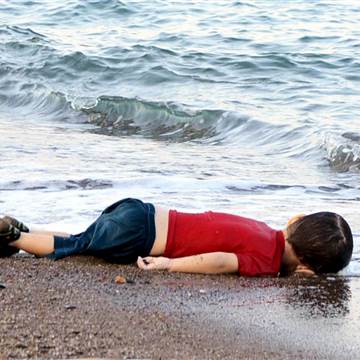
One day later, Aylan Al-Kurdi, another three year old surrounded by loving family, got into a boat dressed in a red t-shirt and shorts. His leap, likely involuntary and caused by waves overtaking the over-packed boat, did not end in smiles and applause. It ended in eternal slumber, face down on a beautiful Mediterranean beach, where tourists promenade. He, too, will be in his parent's arms tonight (at least in my belief system). Most of his family also perished. His family loved him so much that they risked his life and paid thousands of euros to smugglers to escape a deadly and indiscriminate war in Syria that, over a protracted period of five years, has killed civilians and forced over 11 million people to flee for their lives.

Aylan drowned in a failed attempt to reach the Greek island of Kos.
His body was found on the shore in Bodrum, Turkey. (Photo: DHA)
Aylan’s story is now in the center of the maelstrom of the migration and refugee discussions. These discussions race from terms of art to use of images and from Europe’s capacity and willingness to accommodate the influx of people to what needs to be done politically to halt the conditions that force families to risk their lives and abandon everything.

Terms
The word migrant often used, particularly in the pejorative sense. Aylan is more precisely part of a large group of refugees or asylum-seekers who are forced to leave their homes, in this case due to a conflict that is over five years old and that has taken unacceptable tolls on civilians. Aylan and his brother Ghalib are also children, people, humans.


Thursday, July 30, 2015

Isn't it time to lay a symbol of hatred to rest? Why a small northern town does not need the Confederate flag

I grew up in Walton, a small town in upstate New York. This morning, I was reminded of a visit one year ago that highlighted some of the most wonderful things about the town and growing up there: Mom’s lemon meringue pie cooling on the porch, skipping rocks in the creek with my then-four year old nephew, and holding hands with my two year old nephew when we went to pet the donkey across the road. It was a privilege to share the fresh food, crisp air, and bucolic beauty with another generation.

What a surprise, then, to end the day thinking of a post in a Facebook group dedicated to “Things I remember about Walton.” A classmate posted the Salon article about a decision taken by the Delaware County Fair board. Not only will they allow the sale of Confederate flags, but one member of the board stated, “[t]he more of them, the better.”

Why do I care? I live far away and will not be able to attend this year. But this fair, my friends, was the yearly highlight of my young life. It brings thousands of people to my small town. There are animals to admire, funnel cakes to eat, and Ferris Wheels to ride. It brings in valuable revenue to an economically depressed small town. I want people to be able to preserve the small town way of life that offered so much during my formative years. I want to know a place where people leave their doors unlocked, borrow the proverbial (and actual) cup of sugar, and watch each other’s children.

The discussion on the Facebook post unfortunately turned to accusations of bullying and prejudice, and only one person answered my question regarding why the Confederate flag was valuable to her. Most arguments, when not degenerating to name calling, talked about heritage. I felt these lacked strength, not only coming from Northerners, but in contrast to the renunciation of the flag’s heritage by Representative Jenny Horne (R-SC), a descendant of Jefferson Davis.

Wednesday, January 21, 2015

Ebola efforts should focus on women and girls

Today from the World Economic Forum in Davos, the Bank of America published, "The secret to social change," which presents evidence that investing philanthropic dollars in organizations that benefit women and girls yields the greatest impact. They cite numerous studies that reflect both the greater relative impact of giving to groups that are disproportionately disadvantaged, as well as evidence that women are more likely to reinvest money gained through greater employment or education into activities that sustain and nurture families.

This study made me think of my recent mission in Sierra Leone to work on beneficiary communication with Ebola-impacted communities. During my mission, I was visiting with Winnie Romeril, a WHO spokesperson and overheard her discussion with an anthropologist preparing for a BBC interview. The topic was female genital mutilation, a practice that is still widespread in Sierra Leone. On its own, the practice has numerous negative effects on the lives of girls - culturally presenting them as marriageable even before puberty, inflicting painful and dangerous cutting in often non-sanitary conditions and often damaging their ability to conceive and bear children. Combining this with the presence of Ebola, a viral disease that is transmitted through touching bodily fluids, expands the deleterious impact. In the past few months a group of soweis, women who perform female genital mutilation ceremonies sequentially during the months of December and January, contracted Ebola and died. Huffington Post reported last week that the government of Sierra Leone has recently instituted a temporary ban on the practice.

Further, reports in August 2014 reflected that women formed a disproportionate percentage of Ebola deaths, reaching up to 75 per cent in Liberia and from 55 to 60 per cent in Sierra Leone and Guinea. This is due to traditional cultural practices in which women often pay a primary role. Ebola is contagious through bodily fluids - blood, vomit, faeces, semen, saliva - of a person who exhibits symptoms of the disease. In West African culture, women breastfeed and change children, care for the sick, and wash and prepare dead bodies prior to burial. Dead bodies carry the highest viral load for Ebola victims and are the most contagious.

Wednesday, January 14, 2015

The challenge of modifying long-held customs in the midst of an Ebola outbreak

Three weeks ago, a dear friend whom I’ve known for almost 20 years died of breast cancer. I was 5,000 kilometres away on another continent. I wanted to gather with people. I wanted a hug. I wanted to offer my support and help to her husband and three children. Through social media, email and Skype, I reached out to mutual friends and family to give and receive comfort. I tried to find a way to attend the viewing, wake and memorial service, but it was too expensive at the last minute. I was grief stricken and torn at the inability to participate in my cultural funeral practices.

The people of West Africa, particularly Sierra Leone, Guinea and Liberia, are similarly and indefinitely stripped of this privilege. This is not because they have chosen to work far from home; it is because Ebola has stolen from them. Recently deceased victims of Ebola carry the highest viral load. This is how Ebola is transmitted: through infected bodily fluids. People who contract Ebola do so through intimate contact with someone who has symptoms or who has died of the disease. The victims are the most loving of West African society: parents of sick children, people who care for ill family and friends, health workers and people – mostly women - who prepare bodies for burial. These are the ones who touch blood, sweat, vomit and excrement in their efforts to help.

To combat this, education about the disease and convincing people to abandon, indefinitely, their most ingrained customs, is critical. While operating and scaling up treatment, holding centres, and clinical facilities so that sick people can be treated in a safe environment by skilled health professionals is vital, so too must communities learn how to help themselves. Red Cross teams, composed of trained local volunteers who are both familiar with and speak the local dialect, are working in collaboration with community leaders in crowded urban areas and remote mining villages to make this change. They do contact tracing, which involves finding every person who had contact with an ill person and doing daily health checks for three weeks, and social mobilization, which includes sharing information on how to avoid transmission, healthy sanitation habits and self-reporting to a health facility immediately when symptoms develop. Moreover, they guide people to not touch dead bodies at all and to contact the Red Cross to provide safe and dignified burials. This is a difficult message to convey, even to fellow community members, especially as it defies important cultural practices.

Yesterday, I attended the safe and dignified burial of an elderly man in a village in Sierra Leone’s Western District. The village was accessible via heavily rutted dirt roads. Under a leafy tree canopy, the beneficiary communication specialist from the Red Cross talked to the community, his words punctuated by wailing from within the home. After the first part of the conversation, the burial team entered the home, dressed fully in protective gear. To their dismay, the body had been wrapped in a cloth. This action, intended to be kind and respectful, meant that each person who touched the corpse could have been infected. Consulting with the headman, the Red Cross worker spoke again, assuring the community that teams would return promptly to do safe and dignified burials if anyone else died, but pleaded with them to not endanger their friends and family by touching someone.

A tall man in the crowd spoke up, saying the deceased had been an old man who probably didn’t have Ebola. But his symptoms were consistent with the disease, the Red Cross worker said, and many people in the village came in and out every day and could have easily transmitted the disease, especially to an elderly person whose immune system was weaker. He answered more questions, noting each of the details in a telephone survey designed to track epidemiological data and to collect community questions and input, then respectfully departed, letting the community know that Red Cross workers would come to check their health for the next three weeks and to share more information.

The team talked, as our truck bumped back out on the road. We were disappointed that there could be more cases and that educating people about safe burials had not yet been effective. It was then I recognized what an uphill battle we faced. If I had the choice when my friend died, would I have wiped her brow, cleansed her body, and hugged her one more time? Knowing what I do about this deadly disease, I am forced grievingly to say, “not if my life depended on it.” Instead, I found new traditions of sharing words, sending money to her children’s education fund, and praying. I hope the people in West Africa, like me, can also find consolation in similar modified practices.


Catherine Kane is a senior communications officer for the International Federation of Red Cross and Red Crescent Societies. Based in Geneva, she was recently deployed to Sierra Leone to support beneficiary communications initiatives as part of the Red Cross response to the ongoing Ebola outbreak. Republished from IFRC.org

Thursday, January 8, 2015

Finding hope in a community under Ebola quarantine

As we headed into a community in Freetown, Sierra Leone, on Christmas morning, I saw a blue wooden bench at the side of the road, labeled “Long Bench Brotherhood”. It seemed inviting, a perch from which one could see all of the neighbourhood’s activity, but it was empty. I took a photograph, wondering why it was empty on Christmas Day, a day of rest.

A uniformed policeman let the Sierra Leone Red Cross Society team with which I was travelling pass through a series of narrow alleyways into a community of several dozen people. We were in Kingston Bridge to engage with the community for several reasons. They were in quarantine, following several members having gotten Ebola. The Ministry of Health and partners recently scaled up holding centres, where one waits 24 hours for the results of a laboratory test while receiving care, and treatment centres in the Freetown area from 16 facilities to 90. The more recent cases in Kingston Bridge were uncovered quickly. The community had learned from the Red Cross social mobilization and contact tracing teams that sick people must not be touched and that they should call the emergency number, 117, as soon as they are sick in order to receive safe medical care.

Mamvana, an animated man, perhaps in his forties, who described himself as the right hand of village headman Suleiman, met us at the entrance of the community and gathered his family and neighbours. An inviting smell rose from the pot next to me, cooking over a woodstove as we spoke. As a special Christmas treat, his family was cooking a chicken to accompany the potato leaves the young women next to us were chopping. Mamvana, asked by the social mobilization team, described his understanding of Ebola and how the community should protect itself. Multiple discussions with Red Cross community engagement teams over the past few months of intermittent quarantines had helped him and others know what to do, especially now that more treatment centres are available to accommodate the sick, and more rapid pick-up is available to ensure a safe and dignified burial for the deceased.

To the contact tracing team, which comes to the community every day for 21 days after a case is discovered, he proudly announced that everyone in the community was still feeling well. This daily health check is essential to monitor the safety of the community itself, since the virus has an incubation period of three weeks, and to ensure people don’t spread the disease to others in this heavily populated area. Only six more days, he noted, and everyone would be free to leave the community when they wanted and, most importantly, resume gatherings of the Long Bench Brotherhood. Mystery solved!

While Mamvana disappeared into his corrugated tin home to find his favourite photograph of the bench, I spoke with a young woman who had been leaning against a concrete wall during our conversations. Mabinti is one of the strongest people in the world right now. Having come to Freetown to care for her sick auntie, she contracted Ebola. But she survived. Shyly, she described the experience. Mabinti, as a survivor, is now immune to the virus. Still, she is stigmatized by some. Her village would not allow her to return, a difficult challenge for the young woman. Though she has been welcomed into Kingston Bridge by Suleiman and his well-sensitized community members, the psychosocial support offered by the Red Cross will help her rediscover the self-assurance and happiness that is starting to peek through at moments.

Mamvana returned with his photograph, one of his most treasured possessions. The photograph shows the smiling men of the village beside the long blue bench. As we all smiled, thinking of the freedom that will be theirs in less than a week, he led the community in singing, “We wish you a merry Christmas”. Threading my way back through the narrow streets, escorted by the police officers, I hoped and sang again to myself, “and a happy, healthy New Year.”

Catherine Kane is a senior communications officer for the International Federation of Red Cross and Red Crescent Societies. Based in Geneva, she was recently deployed to Sierra Leone to support beneficiary communications initiatives as part of the Red Cross response to the ongoing Ebola outbreak. Republished from IFRC.org

Tuesday, December 30, 2014

Sometimes, it’s the Ebola patients who offer comfort

Tonight, on a sticky and slightly humid evening in Freetown, Sierra Leone, I met Patrice, a nurse practitioner who has returned from working in the Red Cross Kenema Ebola treatment centre. Six weeks ago, she left her family, her job, and her 60 kilogram Great Pyrenees-Mastiff mix dog, to become part of a team that is combating a deadly disease that threatens the fabric of this and surrounding countries.

Patrice, a Canadian Red Cross volunteer, has responded to a number of disasters around the world and said this mission has been both the most remarkable and the most stressful. Red Cross workers in the Ebola treatment centres take extraordinary precautions in their work to ensure a safe environment. Before each shift in the high risk area, Patrice and her colleagues  spent about 15 minutes dressing in layers of personal protective equipment and being checked by a Sierra Leone Red Cross Society volunteer to ensure that no trace of skin was showing. In temperatures that exceed 40 degrees Celsius inside the suit, Patrice spent one hour at a time with patients confirmed to have Ebola. Wrapped in layers of Tyvek, she fed a one year old baby, held a frightened six year old and sang him “O Canada”, and shared news with other patients, while encouraging them to take in the liquids that could save their lives.

Smiling, Patrice told me how eager the patients were to talk to her each day. She brought them stories from the outside world, as well as messages of encouragement and hope from her friends. Ebola experts indicate that rapidly seeking treatment at the onset of symptoms, consuming 4.5 litres daily of oral rehydration solution daily, and having a sense of hope, are all factors that increase Ebola survival rates. For Patrice, being the bearer of well wishes from her generous-hearted friends was a gift.

Her eyes water, remembering one particular experience. She had received news the day before that a young man whom she’d known all her life, a friend of her son, had died suddenly of an unknown cause. As she entered the treatment centre, Aruna, a 26 year old Sierra Leone man who had battled Ebola for three weeks approached Patrice, asking where she had been the previous day; for patients, staff are lifelines not only in the clinical sense, but they become friends who spend their rest time standing at a safe distance on the outside of the centre, chatting with, and encouraging, patients.

Upon hearing Patrice’s story, Aruna, who was slowly recovering from the fight of his life, took her double-gloved hands in his own and looked through her goggles into her eyes. He asked her to send a message to her son and to the family of the young man back in Canada: “You have cared for us and brought us messages of support. Please tell them that Aruna sends his love and his condolences to them in their time of need.” Patrice remembers her goggles beginning to fog with tears, touched and overwhelmed that someone in such great pain and need could focus his attention on a family a world away. This is humanity.

Speaking with Patrice, I recognized my good fortune. I was one of the first to offer her psychosocial support just through listening. And I have seen the light of generosity: her gift of expertise and caring and Sierra Leone’s great spirit of survival and caring for others. If you see Patrice, give her another hug from me.

Catherine Kane is a senior communications officer for the International Federation of Red Cross and Red Crescent Societies. Based in Geneva, she was recently deployed to Sierra Leone to support beneficiary communications initiatives as part of the Red Cross response to the ongoing Ebola outbreak. IFRC.org

Monday, March 18, 2013

Lucky in love

I'm lucky in love. This year, I'm learning to love more in many ways. It is so easy to see a world where one is all alone, no one cares, and slights are deliberate. Today, I feel the love. I want to recognize it, because there is no value unless it's shared.

Last week, I was at a conference 3500 miles from my flat and a challenge arose involving regie (fearsome dragon-like creature that controls real estate in Geneva), neighbor, dogsitter, and two friends, including one who had just been in an accident and was at hospital. To make a long story short, Desmond was lonely, and the dog sitter had been robbed, and my neighbor came to the rescue, simultaneously offering to care for my dog and to call the police if I didn't hand the keys over. We've subsequently (phone calls/texts/emails/apologies from dogsitter/large bunches of flowers) worked things out, and Desmond has a new fan.

A kind friend whom I have not seen for months due to competing schedules stepped in to the breach, at the expense of work time at her finance job for a fancy company. Not only did her sweet demeanor diffuse the neighbor's harangue, but she kept sending reports back to overanxious me. My hero.

When confronted with visa issues, my boss and friend trusted me to take her place at a conference, presenting on behalf of our organization. It was a conference of skilled American Red Cross communicators. I lurk on their closed Facebook group and am a steady admirer of their work and friendship. They welcomed me back warmly, and I made some new friends, in addition to strengthening bonds with long-standing friends and colleagues.

Monday, February 18, 2013

Life in the J Peterman Catalog

The 'Rio de Janeiro' dress was described thus:


We Weren’t Born to Follow
Wonderful, terrifying, possibly clairvoyant. Knocks you out with a glance. Laughs when you can’t get up. Oh yes.

She’s imperfect, real. Flawed but very close to beautiful.

Clear-eyed, knows more than she really wants to. Protects the innocent. Teases the powerful.

“Indecent,” she whispers as she gathers this dress from your warm outstretched hands. “After all these years.”

She gets up around noon and does whatever she does. When she shows up, she’s late. When I put my foot down, she laughs.

When I met her in Rio de Janeiro, she was wearing this.

It whispers with or without a breeze.

Trust me.

The catalog describes a life that doesn't exist for most of us, but its playful escapism makes me smile. So does this charming anecdote.

Sunday, December 30, 2012

Geneve, I think I like you | Genève, je commence à vous aimer

Swiss and Geneva flags at La Treille plaque commemorating 31 December 1813
The plaque I pass daily
without noticing
Tonight, I began to like Geneva a bit more. This evening's walk was punctuated by cannon fire. Yes, you read that correctly. Ambling through the streets of the Vielle Ville, admiring the glow of illuminated snowflakes against the deepening nightfall, we were startled by a loud sound. Curious people (and pup), we walked toward La Treille, where several hundred people were watching and participating in a commemoration of Geneva's release by Napoleon's troops in September 1813 and its declaration of independence on 31 December.  (They were speaking French, but of course Americans speak English...)

Why did this tickle me? I find the Genevois habit of commemorations quite charming. That these secretive and upright people will tog themselves out in historic finery, seemingly at the drop of a hat, shows a touching homage to tradition. The uniforms come complete with furry high hats that remind one of British bobbies, as well as furry backpacks, with blankets (yes, Swiss Army blankets) and tin pots attached.

Thursday, December 6, 2012

An Angel Gets Her Wings

Tonight, as I was changing the lights on my Christmas tree (favorite lights+wrong current=poor idea), I kept accidentally ringing the bells that are nestled on several branches. Each time, I thought of It's a Wonderful Life, where Clarence announces that each time you hear a bell, an angel gets his wings.
For the past month, my friend and former coworker Dawn has been on my mind. She was diagnosed at the beginning of November with late stage cancer that had thoroughly invaded her body. I was invited by one of her dearest friends, another coworker, to join Hugs for Dawn, a Facebook group.

Wednesday, July 25, 2012

Customer Service... Not

Signal #102 that living in Switzerland is different: customer service is about the commercial entity, not the customer.

I called my bank to make a request (email takes several weeks to receive an answer). I need to go in to the bank in person to accomplish what I need. In the particular bank, there are no appointments, so one must go, and there may be a wait, said the receptionist.

Then, I called the rental agency. The one person who handles my rental is out till later. I was asked to call back later (no voicemail and no message-taking on their end).

Friday, December 2, 2011

A wooden leg named Smith

Last night I finished an eleven day conference. As I was pushing my scooter from its parking spot, a car turning the corner ran into me, knocked me down, and ran over my foot. In contrast to my last accident, which happened days before my brother's wedding, this has been a relatively easy experience. The Swiss health care system was incredibly efficient.
My coworkers have been lovely. One escorted me to the hospital and then to my house, where he took Desmond out and even gave me a lesson in how to use crutches. Another took care of bringing my scooter to the office, and yet another took the computers I was carrying. The Danish Red Cross team witnessed the accident, and they gave police statements and cared for me while I was waiting for the ambulance.
Last weekend at TEDxRC2, I saw a presentation by a doctor from Afghanistan who ran a prosthetic clinic. He told us about an afternoon when the streets of Kabul cleared suddenly, leaving only a man, Mahmoud, in the middle of the road. The man had no legs and only one arm. Although the doctor's clinic had been closed by the government as "non-essential," Dr. Cairo asked Mahmoud to meet him there the following morning. The leg-less man, with a line of others, were queued before the doctor arrived.

After Mahmoud received prostheses and learned to use them, he returned to the clinic, asking for a job. He said that he was tired of begging and wanted to do something that would make his family proud. He didn't want a hand-out; he wanted work. The doctor was skeptical, but gave Mahmoud a week's trial. Mahmoud became the most productive worker in the artificial leg factory. This instigated a policy of "positive discrimination," wherein the clinic proactively tries to hire people with disabilities to create opportunity and hope for others. (P.S. Keep an eye on www.tedxrc2.com for the touching video of Alberto's story.)

Tuesday, November 15, 2011

Black Thursday? What next?

The NYT had an article on Veterans Day about stores in the U.S. opening late at night on Thanksgiving evening in order to beat the Black Friday rush. On the same day on Facebook, a friend posted a picture of Nordstrom's sign, which announces that they do not decorate for Christmas until after Thanksgiving. I have boycotted Macy's since 1992, due to their progressively more advanced Christmas decorations, which I believe now appear around Labor Day. Barring the obvious arguments about loving the season you're in and the commercialisation of a religious holiday, I think there are some other considerations afoot with this advance Black Friday movement.

I live in Switzerland. One of the first things I learned about Geneva is that all businesses are closed on Sunday, with the exception of 1) restaurants; 2) bakeries (the Swiss feel fresh bread is a natural right); 3) farmer markets like the one right near my flat; and 4) businesses willing to pay double their employees' salaries for working that day. This is because they view Sunday as a family day. They also close business around 7pm daily and actually in the past few years voted against having later shop hours. The result is that not only is it somewhat harder to get quotidian errands done, but one also does much less mindless shopping. I consume less here - and that's actually rather good.

Friday, November 4, 2011

It Isn't Enough to Love; We Must Prove It

I just finished reading The Happiness Project, picked up during a layover in Atlanta. Tonight, I glanced for the first time at author Gretchen Rubin's site, and her video challenge of the week is to hug more, kiss more, touch more (appropriately, of course). She closes her brief injunction with a quote from St. Therese of Liseux: "It isn't enough to love; we must prove it." (N.B. I know Mom will love this quote, since she urged me to visit her patron saint's chapel last year while I was traveling with a friend in Normandy.)

Reading about a contemporary's search for greater happiness, divided into 12 monthly installments, struck a chord with me, particularly as the reading coincided with the celebration of my birthday, an entree to a new year. I don't know whether to call it stubbornness, procrastination, or simply the hunt for the "just right," but I am still formulating my resolution - my challenge - for this new year of life.

But I'm coming close. A friend posted a birthday wish on my wall, that he hoped this was the beginning of a year full of magic, wisdom and love. And those are the right elements.

Saturday, September 17, 2011

Feeding the Angels

Thursday morning, walking Desmond in the park next to my temporary flat, I noticed a man on one of the benches. He was surrounded by shopping parcels (everyone here uses recyclables!) and was eating something out of a bag. I had noticed a small shed in the far corner of the park weeks before, and Friday, it had a sleeping bag spread out, visible through the bent tin door.
Desmond woofed at him - of course: he's male and a stranger - and then stopped, sidling up to investigate what he was eating. Opportunist. I apologized and shooed Desmond away. And as we returned along the path, the man approached and asked my name and place of origin. He was pleasant and friendly, and yet I did not tarry long, in part because work awaited. His name, he'd said, was Seraphim.

Seraphim stayed with me that day, an invisible presence, but a source of pensiveness and perhaps guilt.

Sunday, September 11, 2011

My Avocation and My Vocation

Years ago, I was reading a favorite author and came across a reference to "Two Tramps in Mud Time," by Robert Frost, an American poet whom my family often quoted. The final stanza struck me then. Its resonance has deepened through my adult years:
But yield who will to their separation,
My object in living is to unite
My avocation and my vocation
As my two eyes make one in sight.
Only where love and need are one,
And the work is play for mortal stakes,
Is the deed ever really done
For Heaven and the future's sakes.
The poem was written in 1934 in the midst of America's Great Depression. The author is chopping wood when two tramps emerge from the forest, one stopping to watch the author, wanting - no, needing - to substitute his own hands on the axe in order to earn a bite to eat, an indoor refuge from the mud and chill of an outdoor bed.

Why do I write about this today? Ten years ago today, on a beautiful Indian Summer September morning, I was working from my home in Arlington, VA.

Thursday, September 8, 2011

Give Us This Day Our Daily Bread

Today was my first holiday, the Jeûne genevois, which is traditionally a day of fasting. The curious - or perhaps less curious once one begins to know Geneva - exception is supposed to be la tarte pruneaux (plum tarte). Being the wonderfully good celebrater that I am, I plunked down my francs for a tarte this morning, when my local bakery was open.

The Swiss take family very seriously. In Geneva, shops are closed Sundays so people can spend time with their families. And from what I have seen of people in cafes, parks and along the lake, this is exactly what they do. Restaurants and cafes can be open... as can bakeries, but any other business must pay its employees 50% extra for working on Sundays. This, in a town where shops close at 1900 daily anyway...

Friday, September 2, 2011

In the Land of Many Fabrics

Thanks to @chris_saeger for referencing the 100th Anniversary of The Secret Garden. Barnes & Noble Community commentator Sarah-W writes about the life of author Frances Hodgson Burnett and reveals this nugget from Burnett's personal writings:
What is there to feed my poor, little, busy brain in this useless, weary, threadbare life? I can't eat my own heart forever. I can't write things that are worth reading if I never see things which are worth seeing, or speak to people who are worth hearing. I cannot weave silk if I can see nothing but calico--calico--calico.
Geneva is, without a doubt, a land of many fabrics. More than one person has remarked that Geneva is not truly Swiss, as most people here are from other lands. Having spent so many years in Washington, watching and welcoming others to my town, it is interesting to be on the other end of the spectrum. In a conversation with "international woman of mystery" Laura G, we discussed approaches to creating a community in a new town.